
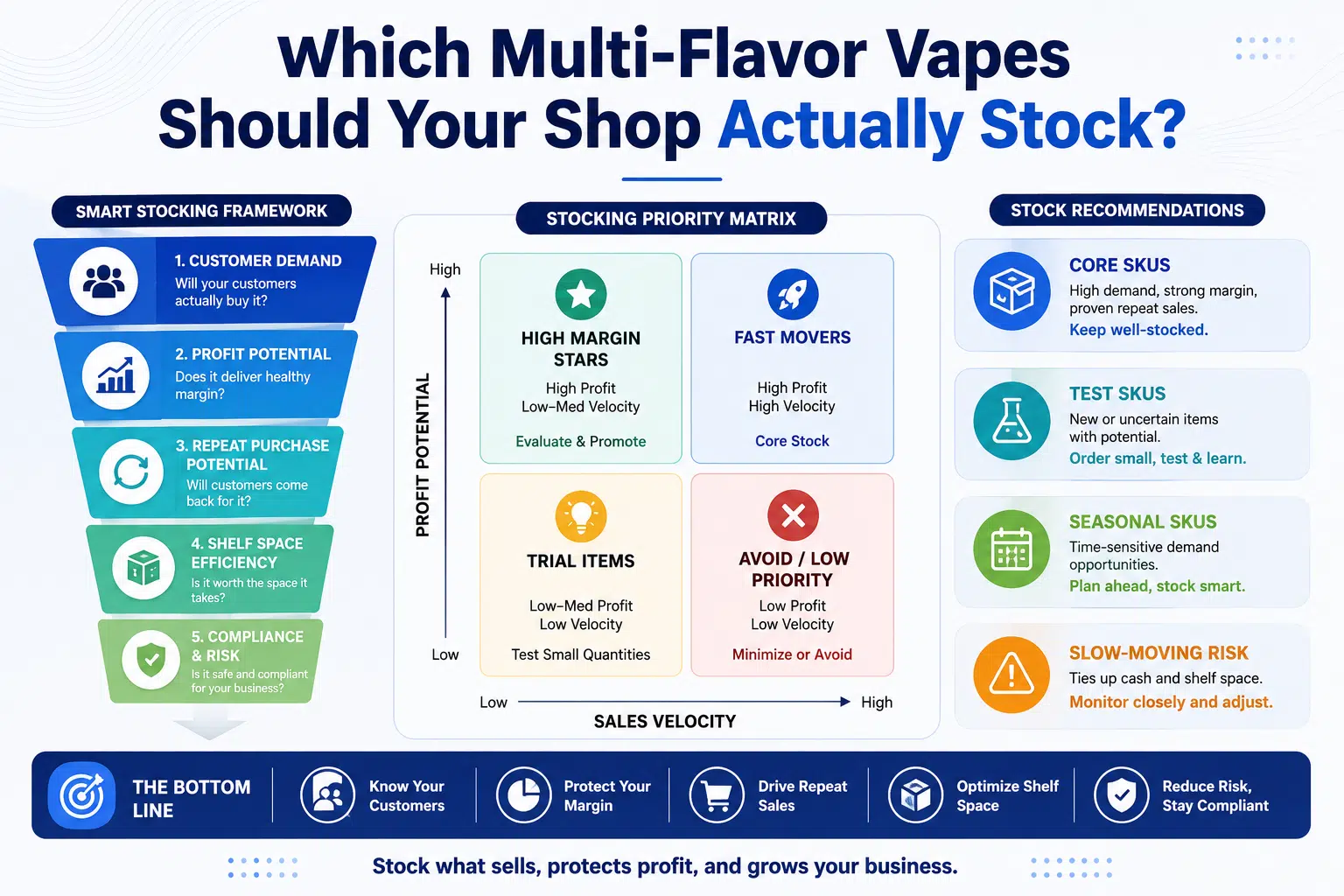
Short answer: Stocking a multi-flavor vape selection is not about carrying every tier from 2in1 to 12in1. It is about pairing the right “traffic brand” (the one customers already search by name in your market) with the right “profit brands” (the ones that give you real margin once a customer is in your shop). Get those two roles right with three to five SKUs, and you have a working multi-flavor section. This guide walks through how to think about both roles, which models fit where, and the common stocking mistakes that quietly tie up cash.
If this is your first multi-flavor stocking decision, start with what is a multi-flavor vape and how many flavors to choose. This article focuses on the wholesale side: which models, in what mix, for what kind of shop.
| The two roles every multi-flavor section needs | What it does | Margin profile |
|---|---|---|
| Traffic brand | Customer walks in asking for it by name. Builds foot traffic. | Lower margin (customer expects competitive pricing) |
| Profit brand | Customer is already in the shop. You convert and earn real margin. | Higher margin (you control the pricing narrative) |
The real way shops decide what to stock
Most stocking guides split products by price tier — entry, mid, premium. That is a customer-side view. The shop-side view runs on two axes at once, not one. A SKU is not just “cheap” or “expensive”; it also occupies a position on a brand-recognition axis. Cross those two axes and you get the matrix that actually drives a small-shop owner’s purchase decisions.
| Low margin (sells on recognition) | High margin (must earn its place) | |
|---|---|---|
| Known brand (customer searches by name) |
Traffic anchor. High-volume SKUs from a brand the local market already searches. | Premium anchor. Higher-tier SKUs of a known brand — customer trusts the brand, accepts the price. |
| New / less-known brand (customer needs to be told) |
Rarely viable. Low recognition + low margin = slow-moving inventory. | Where profit lives. Higher margin compensates for the customer-education effort. This is where most retail profit actually comes from. |
The bottom-left quadrant — new brand at low margin — almost never works. The bottom-right is where most multi-flavor margin lives, because that is the only quadrant where you have room to both educate the customer and earn from the conversion. A balanced shop carries SKUs from both rows: traffic SKUs to bring people in, profit SKUs to actually make money.
The traffic brand depends on your market
“Traffic brand” is a regional position, not a global one. The same brand can be a customer-pull anchor in one country and almost unknown in the next. A few real examples from current European disposable markets:
- ES (Spain) and HU (Hungary): Vapsolo is the search-volume anchor — 27,000+ monthly searches in Spain and consistently strong presence in Hungary. Shops in these markets stock Vapsolo because customers walk in asking for it by name.
- DE (Germany): Fumot occupies that role. The brand-recognition footprint in German-speaking markets is different from Iberian/CEE markets.
- PL (Poland): The local traffic brand differs again. The practical rule: ask your distributor which disposable brand currently has the highest search volume and shop-floor recognition in your region — that brand becomes your traffic anchor.
- Other regions: The same logic applies. Whichever disposable brand customers in your area already know by name is your traffic anchor, regardless of who that is.
For multi-flavor specifically in ES and HU, that means a working selection anchors on Vapsolo multi-flavor models — Vapsolo Quads 80K as the higher-tier traffic SKU, Vapsolo Triple 60K as the entry-tier traffic SKU. They run at lower margin than the profit brands, but they pull customers into the shop in the first place.
The profit brands fill the rest of the shelf
Once a customer is in the shop because of the traffic anchor, the question becomes: what else do they buy? This is where profit brands earn their position. AIRMEZ Fox and Waspe are both newer brands in most European markets right now — customers do not walk in asking for them by name. That works in the retailer’s favor on margin: because recognition is still being built, the wholesale price leaves room for healthier markup at retail.
The multi-flavor positioning for each:
| Brand | Multi-flavor models | Best stocking role |
|---|---|---|
| AIRMEZ Fox | 2in1 · 4in1 · 6in1 · 8in1 · 12in1 | Full-tier profit brand. 4in1 anchors the high-turn middle; 6in1/8in1 take the profit-tier; 12in1 is the premium showcase. |
| Waspe | Twins · Triple · 100K 4in1 · 6in1 150K · 8in1 Crystal 180K | Complementary profit brand. Fills tiers AIRMEZ does not cover or where a second option helps avoid SKU concentration. |
The pattern across most working European shop assortments: one traffic-brand multi-flavor SKU pulls people in, two to three profit-brand SKUs from AIRMEZ Fox and/or Waspe convert and earn margin.
Three stocking strategies by shop temperament
How aggressively a shop owner leans into the profit-brand side depends on temperament and customer base. Three patterns we see:
Conservative (lower risk, slower margin growth)
Heavy on traffic, light on profit brands. Roughly: 60% traffic-brand SKUs, 30% profit-brand SKUs, 10% premium/showcase. Suits shops in price-sensitive locations where customers compare prices aggressively and brand-recognition trumps margin. The trade-off: revenue comes in, but margins stay thin.
Balanced (the most common middle path)
Roughly 30% traffic-brand SKUs to pull people in, 50% profit-brand SKUs to actually earn, 20% premium SKUs (12in1, 8in1) for shelf credibility and high-ticket walk-outs. This is the mix most established small shops settle into after a year or two of operating.
Aggressive (higher margin, requires customer-education effort)
Roughly 20% traffic, 50% profit, 30% premium. Suits shops in higher-income areas or specialty/premium positioning, where the staff is willing to spend time explaining newer brands and the customer expects a curated selection rather than the cheapest option. Margin is higher but inventory turn on the premium tier is slower.
None of these is “right.” They reflect different local conditions and different owners. The point is to be deliberate about which pattern you are running — most stocking problems come from drifting between patterns without committing to one.
Common stocking traps
Four assumptions that quietly cost shops money on multi-flavor inventory.
Trap 1: “Stocking only the known brand is safer”
A shop that only carries the traffic-anchor brand has constant foot traffic but thin margins — the customer compares your price to every other shop’s price on the same brand, and the brand owner sets the ceiling. Without profit brands behind the anchor, you sell volume and earn very little per unit. The traffic brand is bait, not bread.
Trap 2: “New brands are risky, stick with what customers know”
This is the opposite trap, and it sounds prudent until you do the math. A new-brand multi-flavor SKU at higher margin earning 30% gross on lower volume usually outearns a known-brand SKU at 15% gross on higher volume. The risk is not “new brand” itself — it is stocking too many new-brand SKUs at once before any of them gets traction. One or two well-chosen profit-brand SKUs, sold actively by the shop, is the standard play.
Trap 3: “Highest puff count = best value, so it sells fastest”
Higher puff count is correlated with higher price, not faster turn. A 300K-puff SKU at €25 retail moves slower than a 60K-puff SKU at €10, even though the per-puff math favors the 300K. Premium tiers are for shelf credibility and the small share of customers shopping at that level — not for volume. Stocking deep on premium because “it has the best value” is one of the most common multi-flavor inventory mistakes.
Trap 4: “Carrying every tier from 2in1 to 12in1 looks professional”
It does the opposite. A full lineup ties up cash in slow-moving SKUs at both extremes (low-end 2in1 and high-end 12in1 each turn slowly) and signals to the customer that the shop has not thought through its selection. A curated three-to-five-SKU multi-flavor section — chosen for the local market’s traffic brand plus complementary profit brands — generally outperforms a fifteen-SKU “complete” lineup. (The same principle for single-flavor vs multi-flavor stocking ROI is covered in the multi-flavor value guide.)
Where bestpuffs.shop sits in this picture
A working multi-flavor shelf usually needs SKUs from two or three different brands — one for the traffic anchor, one or two for profit brands. Sourcing those from separate distributors means separate orders, separate freight, separate payment terms, separate tier-pricing math.
bestpuffs.shop currently carries Vapsolo (the traffic anchor for ES and HU), AIRMEZ Fox (profit brand, full multi-flavor lineup 2in1 through 12in1), and Waspe (complementary profit brand) alongside three other brands — all from a single EU-Poland warehouse. For a small shop, that practically means a single order can cover the traffic-plus-profit pairing without splitting across suppliers. Whether that is useful depends on whether you are already happy with your current sourcing setup. If you are, this article is just a frame for thinking about your existing mix. If you are not, the matrix above maps directly onto what bestpuffs has available.
There is no claim here that bestpuffs is uniquely positioned in some special way that other suppliers are not. Wholesale disposable vape is a competitive space, and most suppliers compete on price, service, selection, and follow-through. The honest position: bestpuffs happens to have a brand mix that maps cleanly onto the traffic-plus-profit framework, which makes it convenient for shops that want both roles from one source. Whether convenient is enough to switch suppliers is a judgment only the shop owner can make.
Frequently asked questions
How many multi-flavor SKUs should a small shop stock?
Three to five SKUs is a working baseline for most small shops: one traffic-anchor SKU from the locally recognized brand, two to three profit-brand SKUs across different tiers (4in1, 6in1, possibly an 8in1 or 12in1 for shelf credibility), and optionally a low-end 2in1 if the local market demands it. Going beyond five SKUs typically ties up cash without proportional sales growth.
Which multi-flavor brand should I stock in Spain or Hungary?
In Spain and Hungary, Vapsolo carries the highest search recognition for disposable vape — customers walk in asking for it. Stocking a Vapsolo multi-flavor model (Quads 80K or Triple 60K) gives you the traffic anchor. Pair it with AIRMEZ Fox or Waspe multi-flavor SKUs for the profit-margin side of the assortment.
Are higher puff counts (8in1, 12in1) worth stocking?
Yes, but not for volume. Premium-tier SKUs work as shelf credibility and capture the small share of customers shopping at that level. Stocking one or two units of an 8in1 or 12in1 is usually enough — going deep on premium ties up cash on slow turn.
What is the minimum order quantity for multi-flavor SKUs?
At bestpuffs.shop, the standard MOQ is 10 units per SKU. That means a small shop can test a new multi-flavor SKU with 10 units rather than committing to a case of 50 or 100. Combined orders across multiple SKUs and brands ship together from the EU-Poland warehouse.
Should I stock independent-switching or Pure + Mix multi-flavor devices?
Both. Independent-switching (2in1, 3in1, 4in1) covers customers who want distinct pure flavors. Pure + Mix (6in1 and above) covers customers who want more variety from fewer favorites. A balanced shelf usually includes both — the proportion depends on local preference. The mechanism difference is covered in how flavor switching works.
This article is part of our complete guide to multi-flavor vapes — see the full guide for the underlying mechanism, decision frameworks for end users, and category trends.
This article is intended for adult business buyers (18+). The products discussed contain nicotine, which is an addictive substance. Wholesale buyers are responsible for compliance with the regulations applicable to nicotine product sales in their own jurisdiction.
