
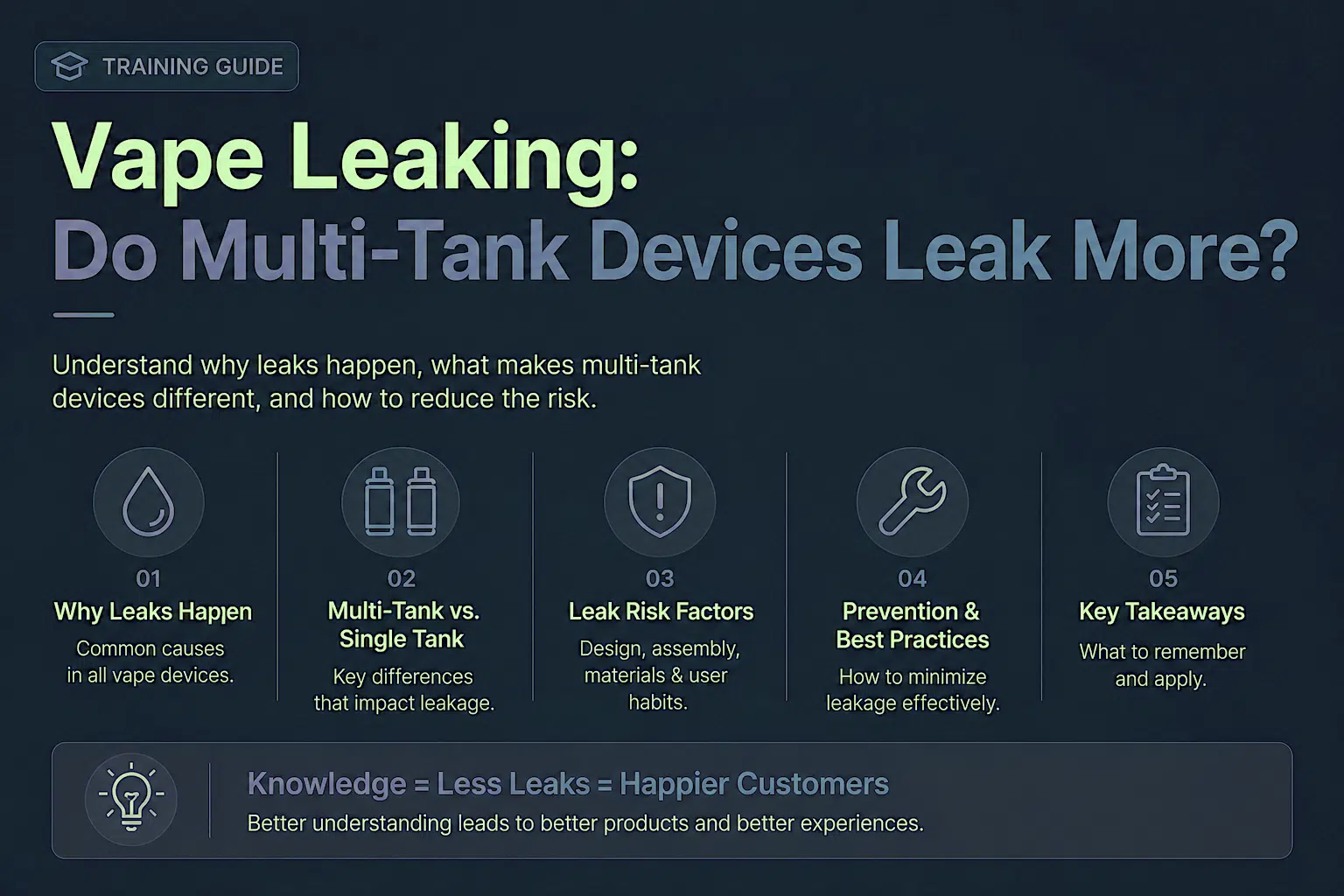
The short version: Vape leaking is the hardware question multi-tank buyers ask first, and the intuition behind it sounds reasonable — more tanks means more seals, so more places to fail, right? The engineering answer is no: tank count is not a leak variable. What actually determines leak risk is how well the design handles the airway-to-tank interface under the two physical triggers that cause virtually all vape leaking — temperature swings and pressure changes. A device that handles that interface well doesn’t start leaking because it has four tanks instead of one; a device that handles it badly can leak with a single tank. And the honest industry context: leaking is far less common today than it was a few years ago, because exactly this structural problem is what manufacturers have spent design cycles solving. The second hardware question — “will the battery last through all the tanks?” — has an even cleaner answer: on high-capacity devices the battery is rechargeable, so the battery is the renewable resource and the e-liquid is the clock. This article covers both, layer by layer.
This is part of our complete guide to multi-flavor vapes — see also why flavors can’t cross between tanks, which covers the sealed-unit architecture this article builds on.
| Hardware worry | The intuition | The engineering reality |
|---|---|---|
| “More tanks = more leaks” | More seals means more failure points | Leak risk lives at the airway-tank interface design, which repeats identically per tank — count doesn’t degrade it |
| “Disposables just leak” | Carried over from earlier device generations | Temperature/pressure handling has been a primary design focus; leaking is far less common than it used to be |
| “The battery won’t last through all the tanks” | More e-liquid needs more battery than one charge holds | High-capacity devices recharge (typically USB-C); battery is renewable, e-liquid is the finite resource |
The intuition isn’t dumb — it’s just pointed at the wrong variable
Let’s give the worry its due. A multi-tank device does contain more sealed chambers than a single-tank device, and “more parts, more failure points” is usually sound engineering instinct. If tanks were loosely partitioned compartments sharing thin walls, the instinct would be right. But as we covered in the flavor isolation article, each tank in a properly built multi-flavor device is its own fully closed, separately molded static unit. A multi-tank device is not one container with more holes in it — it is several sealed units, each repeating the same proven structure. The seal count goes up; the seal design is the same one, repeated. And it’s the design, not the count, that decides whether anything ever escapes.
What actually causes vape leaking: two physical triggers, one design variable
Virtually all vape leaking traces back to two pieces of physics that act on every device ever made, single-tank or multi-tank alike:
- Temperature swings. E-liquid expands when it warms. A device left in a hot car or moved repeatedly between cold outdoors and heated indoors experiences pressure cycling inside the tank as the liquid expands and contracts.
- Pressure changes. Lower ambient pressure — most commonly on flights, sometimes at high altitude — means the air inside the tank pushes outward harder relative to the outside. The pressure differential tries to push e-liquid out through whatever path exists.
Both triggers push on the same place: the airway-to-tank interface — the one point in the structure where the sealed liquid chamber meets an open air channel, because a vape must let air through to work. This is the design variable that separates devices that leak from devices that don’t. If the geometry of that interface is handled well — how the airway routes relative to the tank, where the liquid sits relative to the channel under expansion — then temperature and pressure cycling stay contained. If the design handles it poorly, e-liquid finds the airway under stress. Tank count appears nowhere in this equation: each tank in a multi-flavor device carries its own interface, built to the same geometry. Four well-designed interfaces are exactly as tight as one well-designed interface. One badly designed interface leaks regardless of how few tanks the device has.
The honest industry context: this problem has been getting solved
Vape leaking was genuinely more common in earlier device generations, and some of the reputation lingers from those years. The reason it has become much less common is not luck — the airway-tank relationship is precisely where manufacturers have concentrated structural design work, generation after generation. Better interface geometry, better condensation management, better tolerance control. The result, observed from the wholesale side of the industry: leaking today is the exception, not a category norm. We won’t claim it never happens anywhere — physics is physics and damaged units exist — but “disposables leak” as a general expectation describes the market of several years ago, not the current one. And to repeat the core point: nothing about that improvement curve is undone by adding tanks, because the thing that improved is the per-tank interface design that multi-tank devices simply repeat.
One more structural advantage: nothing is ever opened
There is a quiet reason factory-sealed disposables — including multi-tank ones — sit at the low-risk end of the leak spectrum: their tanks are filled and sealed once, at the factory, and never opened again. Compare that with refillable systems, where leak risk concentrates around exactly the moments the system is opened — unscrewing, refilling, reseating seals, with O-rings that wear over repeated cycles. A multi-flavor disposable has zero open-and-refill events in its entire life. Every tank is a static sealed structure from the production line to the bin. The format that holds the most separate liquids is also the format that never asks you to handle any of them.
Practical care: the short honest list
Because the triggers are temperature and pressure, sensible care is simply avoiding the extremes — and this applies identically to every vape, whatever its tank count:
- Don’t leave the device in hot environments like a parked car in summer — heat expansion is the most common avoidable stressor.
- On flights, expect that cabin pressure changes stress every vaping device equally; carrying it in a sealed bag contains any seepage, and this is airline-and-physics advice, not a multi-tank issue.
- Avoid leaving the device mouthpiece-down for long periods — gravity plus time works on any liquid container.
That’s the whole list. Notice that none of it is multi-tank-specific — because there is no multi-tank-specific leak behavior to manage.
The battery question: “will it last through all the tanks?”
The second hardware reliability worry has the cleanest structural answer in this article. The concern goes: a multi-flavor device carries a lot of e-liquid — if the battery dies before the tanks are empty, the remaining flavors are stranded. The answer: on high-capacity multi-flavor devices, the battery is rechargeable, typically over USB-C. That single fact reorders the whole question. The battery is not a fixed fuel tank racing against the e-liquid — it is the renewable resource in the device. You recharge it as many times as the e-liquid requires. The e-liquid is the clock; the battery just keeps ticking alongside it.
This also reframes what “battery life” means on these devices: it describes how long one charge lasts between top-ups, not how long the device lives. A device’s life ends when its e-liquid ends — a point we made from the value angle in our multi-flavor vape value analysis, where e-liquid capacity in ml, not battery specs and not puff counts, is the honest measure of how much device you bought. Rechargeable battery cycles comfortably outlast a single fill of e-liquid; “stranded tanks” is not a failure mode the architecture allows.
One related reliability note that connects to our flavor switching guide: on mechanically switched multi-flavor devices — the dominant design — the battery powers exactly one thing, the coil. Switching is physical, the flavor indication is physical, so there is no mode-control electronics standing between a charged battery and a working device. Fewer electronic subsystems is fewer things that can fail; the reliability argument and the switching argument are the same argument.
The retail angle, in one paragraph
For shop staff, the leak question usually arrives as inherited folklore — “I heard these leak” — rather than direct experience. The effective counter-answer mirrors this article’s core: leak risk lives in design quality, not tank count, and the design problem is one the industry has spent years solving; today’s well-built multi-tank devices are factory-sealed units that are never opened in their entire life. For which multi-flavor formats deserve shelf space, see our multi-flavor stocking guide.
Frequently asked questions
Do multi-flavor vapes leak more than single-flavor ones?
No. Vape leaking risk is determined by how well the design handles the airway-to-tank interface under temperature and pressure stress — not by how many tanks the device has. Each tank in a multi-flavor device is its own sealed static unit repeating the same interface geometry, so a well-designed interface is exactly as tight whether the device has one tank or four.
What actually causes a disposable vape to leak?
Almost all cases trace to two physical triggers: temperature swings (e-liquid expands when warm) and pressure changes (flights, altitude). Both push e-liquid toward the airway-tank interface, and whether anything escapes depends on how well that interface is designed. Leaking is far less common today than in earlier device generations, because this interface is exactly where manufacturers have concentrated structural improvement.
How do I prevent my vape from leaking?
Avoid the two triggers: don’t leave the device in hot environments like a parked car, expect pressure stress on flights and carry it in a sealed bag, and avoid storing it mouthpiece-down for long periods. These apply equally to every vaping device regardless of tank count.
Will the battery die before all the tanks are empty?
No — high-capacity multi-flavor devices use rechargeable batteries, typically USB-C. The battery is the renewable resource and the e-liquid is the finite one: you recharge as many times as the e-liquid requires, and the device’s life ends when its e-liquid ends, not when a charge runs out. Stranded tanks are not a failure mode the architecture allows.
My device is leaking anyway — what should I do?
A unit that leaks under normal storage and use is the exception rather than the norm in current devices, and most likely reflects transport damage or an individual defect rather than a design property. Stop using it and contact your seller — a damaged unit is a replacement case, not something to troubleshoot.
This article is part of our complete guide to multi-flavor vapes — for the flavor isolation architecture, switching mechanisms, value analysis, and stocking advice, see the full guide.
This article explains device engineering for adult users only (18+). These products contain nicotine, which is an addictive substance.
